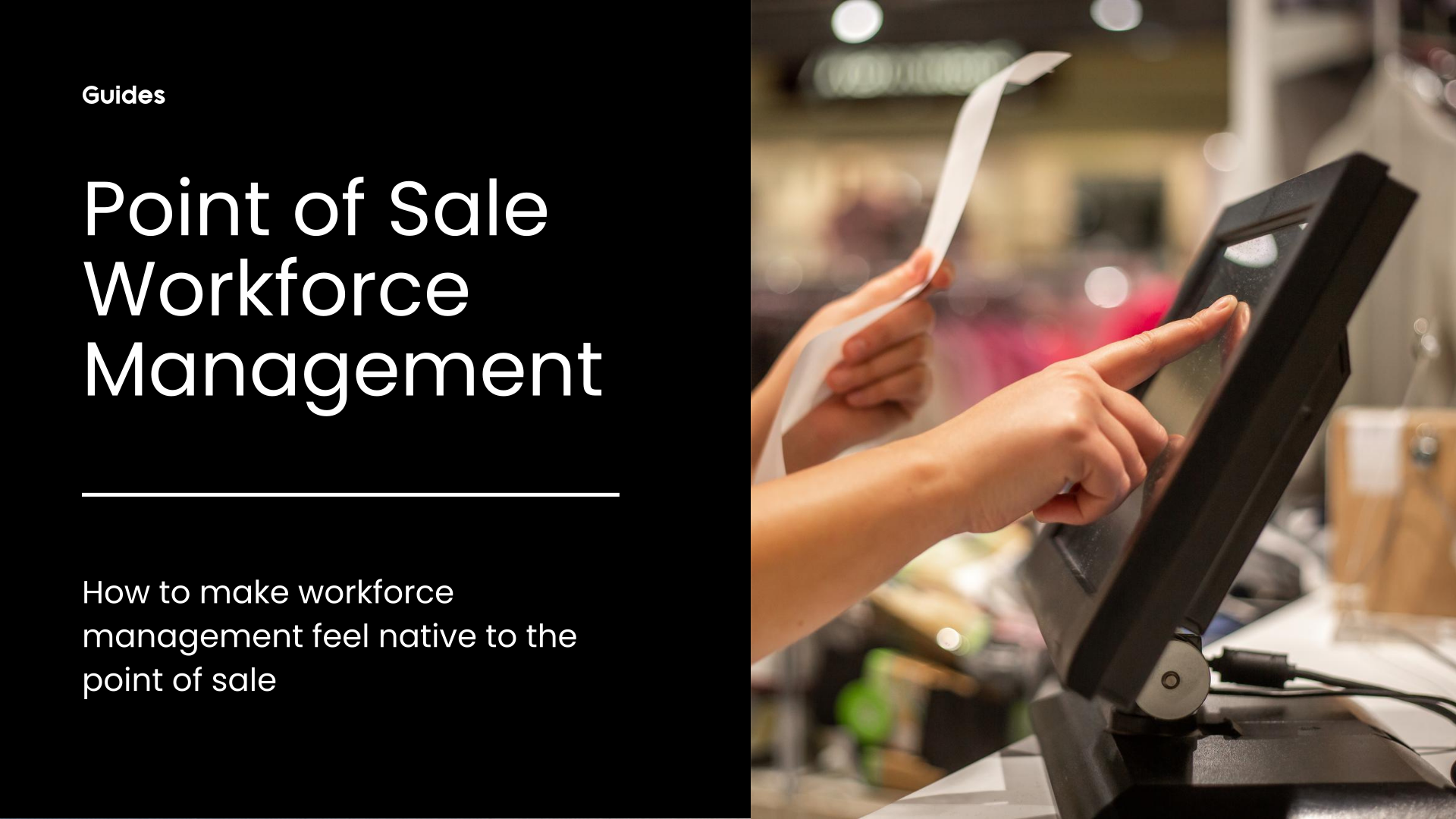
The modern POS has become the center of gravity for retail operations. For multi location retailers - whether it is apparel, cafés, salons, or restaurants - the POS is the one system staff can count on being physically present, powered on, and shared across the entire shift. It is where time tracking happens because it is always there, where commissions make sense because sales originate there, and where schedule visibility lives because teams show up to the POS long before they open their personal phones.
Most retail operators do not want their frontline teams jumping across separate apps, downloading third party tools, or learning new workflows every time the business expands. They expect workforce management to exist inside the POS they already know - not floating somewhere adjacent. And that expectation reshapes how workforce management must be built.
Easyteam has spent years powering deeply integrated, POS native workforce management across retail and hospitality. What follows is a view into why these needs exist and how to meet them without introducing operational friction or architectural fragility.
The Shared Device Reality
The POS is typically a single device used by many employees throughout the day. That one device might support ten or more staff members, all clocking in and out, switching roles, splitting shifts, or handling breaks.
This environment creates a set of constraints that do not exist in mobile first workforce apps:
- Staff authenticate quickly, usually with a PIN code
- Everyone interacts on the same piece of hardware
- Managers watch foot traffic, customers, and staff simultaneously
- Late clock ins, missed breaks, and mid shift transfers happen constantly
In this setting, the workforce layer cannot rely on persistent sessions, personal devices, or biometrics tied to individual hardware. It lives inside the operational tempo of the store.
Easyteam treats this as a first principle rather than a compromise. A shared-device POS is not a limitation - it is the native execution environment of retail.
Buddy Punching: The POS-Specific Challenge
When multiple staff authenticate on the same screen using a four or six digit PIN, buddy punching becomes an immediate risk. Retailers know it well: a friend enters someone else’s PIN and clocks them in early, or avoids clocking them out late. A POS can easily become the most expensive unlocked door in the store.
Solving this requires multiple enforcement layers because no single method is enough for every retail environment or every staffing model:
Camera photos
A quick photo capture at clock in and clock out provides a clear audit record. But in stores with 10, 20, or even 40 staff rotating through one location, managers do not have time to inspect images every day. Photos are useful for forensic review, not continuous enforcement.
Device ID restrictions
This prevents employees from clocking in on any device other than the authorized POS hardware. It eliminates off site or back room clock ins and ensures that every shift event originates from the correct location. In high volume retail, this is essential.
Geofencing
Geofencing provides a secondary perimeter for teams that occasionally use mobile flows but need tight boundaries around the store. It is particularly effective for multi location companies where staff float between sites.
Easyteam ships all these layers out of the box and treats them as composable enforcement modes. POS platforms integrate once and can toggle the enforcement levels per merchant, per location, or per team. The result is a workforce system that fits the operational reality rather than forcing policy tradeoffs.
A Native POS UI: Why Retail Cannot Tolerate a “Plugin” Feel
Retail operators hire constantly. Staff churn, seasonal peaks, and part time roles mean new people appear in the store every week. Managers do not have time to train them on new workforce tools or explain why clocking in requires leaving the POS they already understand.
This is why the workforce UI must feel indistinguishable from the POS UI. Same visual hierarchy. Same button placement. Same startup flow. Same sound cues. Same identity model.
If the workforce layer looks foreign, adoption collapses. If it matches the retail muscle memory built around the POS, usage becomes automatic.
Easyteam’s embedded approach is designed for this exact requirement. The POS owns the look and feel. Easyteam provides the infrastructure beneath it - scheduling logic, event ingestion, compliance rules, payroll connectivity, commissions processing, break handling, and multi location identity models - while allowing the POS to render the exact UI their merchants expect.
This is the difference between embedding a workforce engine and bolting on a workforce app.
The Invisible Infrastructure Behind a Native Workforce Layer
When a POS wants to offer workforce management, most of the complexity is not visible to the staff or even the managers. But the engineering teams building the POS experience it immediately.
A true workforce layer requires:
A multi tenant scheduler that handles timezone boundaries, shift swaps, late edits, and multi location roles.
A shift event engine that processes clock entries idempotently, ensuring duplicate submissions or unreliable connectivity do not create payroll disputes.
A compliance engine that enforces break rules, minors laws, overtime calculations, split shift premiums, and jurisdiction specific regulations.
Device identity models that tie workforce events to specific hardware in the store.
A permissions architecture that aligns with POS roles while supporting managers, supervisors, and shift leads.
A webhook system that allows POS platforms to receive shift and schedule updates in real time without trapping them in polling loops.
Downstream payroll connectivity that ensures all hours, breaks, earnings types, and commissions flow cleanly into whatever payroll system the merchant uses.
Most POS systems can build the UI for clock ins. The difficulty comes in operating a reliable, compliant, multi location workforce platform at scale - something that appears simple in a store but is extremely complex in the backend.
Easyteam is built specifically for this infrastructural gap. POS companies integrate the workforce layer once, using their own UI, and Easyteam handles the operational and compliance burden beneath it.
Where This Matters: Retail Clothing Stores, Cafés, and Restaurants
The environments Easyteam supports show how varied the constraints can be.
In clothing stores, staff often bounce between the floor, fitting rooms, and back stock. Clocking in at the POS keeps identity anchored in one place even if the shift moves.
In cafés, morning peaks are chaotic and managers need clock ins to take seconds, not a full authentication ceremony.
In restaurants, servers often hold multiple roles, split tips, and earn commissions - workflows that only make sense if the POS and workforce layer share the same source of truth.
Across all these settings, the POS becomes the reliable surface for workforce events because it is stable, shared, and mandatory for operating the business. That is why embedding workforce management in the POS is not a feature request - it is an operational necessity.
A Workforce Layer That Belongs Inside the POS
Delivering a native frontline experience is not about adding a time clock to the POS. It is about building a workforce system that respects how retail actually runs: shared devices, rapid staff changes, multi location operations, compliance obligations, and the need for managers to solve problems in seconds, not minutes.
Easyteam enables POS platforms to offer this seamlessly. The platform stays loyal to its own UI, its own workflows, and its own merchant experience. Easyteam provides the depth beneath it - the event integrity, the compliance layer, the multi location identity models, the schedule logic, and the anti buddy punching controls that retail demands.
For the POS, the result is straightforward: workforce management that feels native, works reliably, scales with merchants, and does not require supporting another ecosystem.
When workforce management is truly embedded inside the POS, the frontline experience becomes exactly what retail expects - simple, immediate, and built into the device they already trust.